/ 8 min read
Being equanimous - 10 days vipassana meditation experience
I won’t be covering what Vipassana is or the related Pali jargon in this blog. There are numerous resources available online, including the official Dhamma website [0]. Ideally, it is advised not to read about others’ experiences before taking the course. This is one of the major reasons for following Noble Silence throughout the course as well. Students can develop a craving for others’ experiences or an aversion if similar experiences don’t occur. If you’re planning to do Vipassana in two weeks or so, consider skipping reading this if you’re doing it for the first time. If you’re curious to know my experience or you’re being sceptical about taking the course, this article may help. No LLMs were used in writing this article. Consider not using one for summarising this as well if you can.
I’d been wanting to do Vipassana since my college, but I couldn’t find the time or centre available to do that. This time, I finally managed to find some time soon after I quit my job. I was feeling deeply disconnected from myself for quite a while. While signing up for Vipassana, I thought I’d get more mental clarity. After the 10-day course, I realised I was so wrong. Yet, I consider this one of the best decisions I’ve made. I was applying three weeks before the days I’d planned on taking the course. Only a few centres were available within that short timespan. The Dhamma website supports searching for vacant centres[1]. I applied to Dhamma Shringa in Kathmandu and got accepted around two weeks later after an interview with the teacher. I’d written about the meditation techniques I’ve been doing before in the application, thinking that would increase my chances of acceptance. This resulted in the opposite way, though. The teacher discouraged me from doing Vipassana since I’d been practising other techniques. He said that there are chances of techniques getting mixed up. I told him I still want to do Vipassana, and he obliged.
I wasn’t sure if I would have the energy without eating dinner for 10 days with my fast metabolism because I have never fasted in my life. To my surprise, I felt more energetic than on my normal days. The diet they provided included lots of carbs, protein and vitamins. I didn’t feel any difficulty in waking up at 4AM to 3 degrees, nor in not using any electronic devices, not talking or not making eye contact with anyone. I missed speaking to the people whom I was close to, though. The only issue I had was severe back pain. The first couple of days, we were asked to observe our breath. I thought it’d be easy for me because I used to meditate before. I was wrong. That humbled me. Discourses by SN Goenka were played every evening. The first day’s discourse blew my mind. He explained why we’re asked to observe the breath, not to regulate. The goal wasn’t to concentrate the mind, instead to go to the deeper layers of unconsciousness and free the mind. On the third day, I requested back support and the teacher agreed. I almost slept with the back support because I wasn’t feeling any pain. That day, my mind started to calm down as well. On the fourth day, the technique of Vipassana was taught. Honestly, it was very underwhelming for me. The technique was very similar to one of the techniques which I used to do, but with very subtle differences. Little did I know how much change that could make. I’m deliberately omitting some details so that you’ll get first-hand experience from your own course.
I’d followed all the instructions without even a tiny bit of scepticism or expectations. Nothing remarkable happened till day 6. I was just observing all sensations coming to my body. The teacher would call people in a group to closely observe them and clear their doubts. It was hard for some people to observe the sensations. Being a highly sensitive person, this was quite easy for me. All my life, I thought that was a curse. This time, I felt it was a blessing. On the sixth day, I tried to observe pain just like the teacher told me. Instead of trying to change the posture when it was uncontrollable pain, I tried to find the centre of painpoint. I could feel that the centre was shifting and the pain was reducing. Eventually, the pain disappeared. I managed to not react to that and continue meditating for an hour. After the bell rang, I got up. I could barely walk because of the pain for a couple of minutes, and then the pain disappeared again. There’s one of my favourite quotes from Haruki Murakami from his book, “What I Talk About When I Talk About Running”. He says, “Pain is inevitable, but suffering is optional”. At that moment, I felt it.
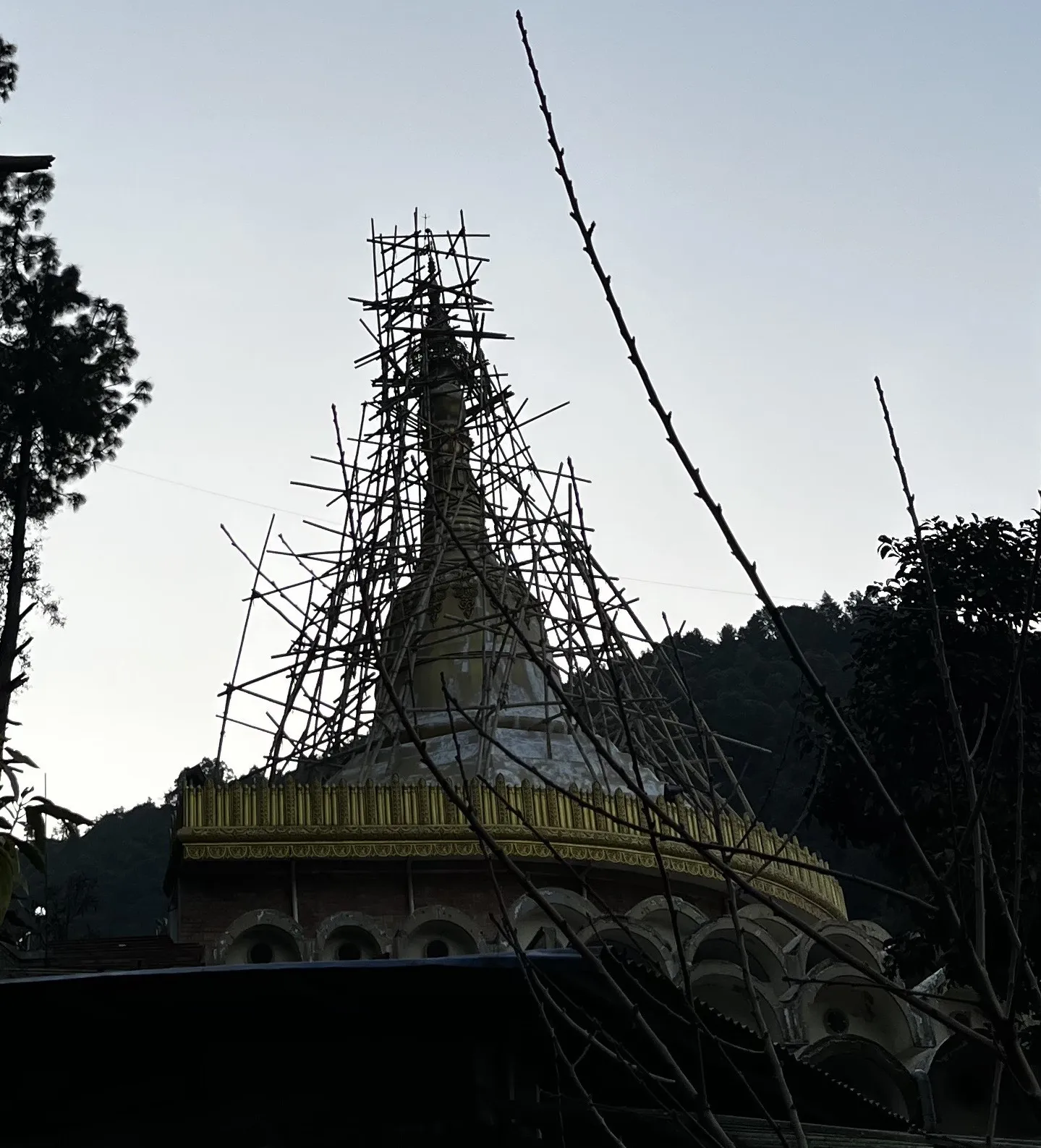
Dhamma Shringa Pagoda, Kathmandu
Another day passed by, and I practised the technique patiently. When I was meditating on day eight, a server interrupted and asked me to come out of the common hall with my blanket. Usually, people who were continuously coughing or sneezing were moved into different halls. I came out confused, thinking if I did something wrong. To my surprise, there were a bunch of others as well. We were asked to take steps uphill leading to a beautiful building. Soon after reaching inside, I figured it had individual meditating cells with terracotta cooling. I turned the lights off. It was pitch dark and quiet. I started meditating. Soon enough, I started seeing a deep blue sea and two whales flying. I began to crave more visuals, but they began to disappear slowly. I felt upset. The visuals started disappearing even faster. Then, I remembered the main teaching of Vipassana - everything is impermanent, sensations arise to pass, be equanimous to all sensations, pleasant or unpleasant. I continued to meditate. The image started to appear again. Soon, I experienced a free flow of sensations throughout the body from toe to head. I began to feel like this energy is flowing upwards, and my body is getting lifted. I thought I was going to die. I stopped the meditation, and the bell rang. The same day discourse explained what I might have experienced. It was called ego dissolution - one of the sixteen insights[2] of Vipassana. I cleared my doubts with the teacher and asked if what I experienced was normal. He smiled and said it was normal and asked me to keep following the technique. I, being curious, requested the meditation cell visit again with a lot of craving. Unfortunately, that time I couldn’t even feel the sensations on my body or meditate properly. That made me experience the misery in craving first-hand. A couple of hours later, during the meditation session, it was told that we may experience sensations not coming at all at some point, and it is not a bad thing to worry about. Being patient and continuing the process leads to feeling the sensations again. A lot of experiences I had kept coming to mind - both pleasant and unpleasant. These come with some sensations. By merely observing them instead of reacting to them, I learned to be equanimous with the situations because all the external events, both good or bad, create sensations on the body too. The Noble Silence was broken on the tenth day, yet I didn’t want to talk to anyone. Some spoke to me, and we shared the experiences. After the Noble Silence was broken, the meditation sessions were less intense.
On how it helped me and how it can help you, I’d say it depends on people. I can say that for me, it gave me a new perspective on living. We can’t avoid unexpected pleasant or unpleasant situations. Vipassana taught me how to remain equanimous in these situations. There is a movie scene[3] from The Karate Kid(1984), where Mr. Miyagi asks Daniel to clean cars using Wax On, Wax Off when he asks to teach Karate. Later, when Daniel gets frustrated after chores, Mr. Miyagi shows[4] him the power of the technique from muscle memory. Vipassana works like that. Have faith in the process, and you’d be surprised to see how you experience it. For a better experience, consider that I’m blatantly lying about my experience throughout this post.